
Hammersmith Bridge: Council report indicates cars may never return
A major London crossing may remain permanently closed to motor traffic after a new council report concluded that full restoration is financially unfeasible, according to findings reported by Hammersmith & Fulham Council.
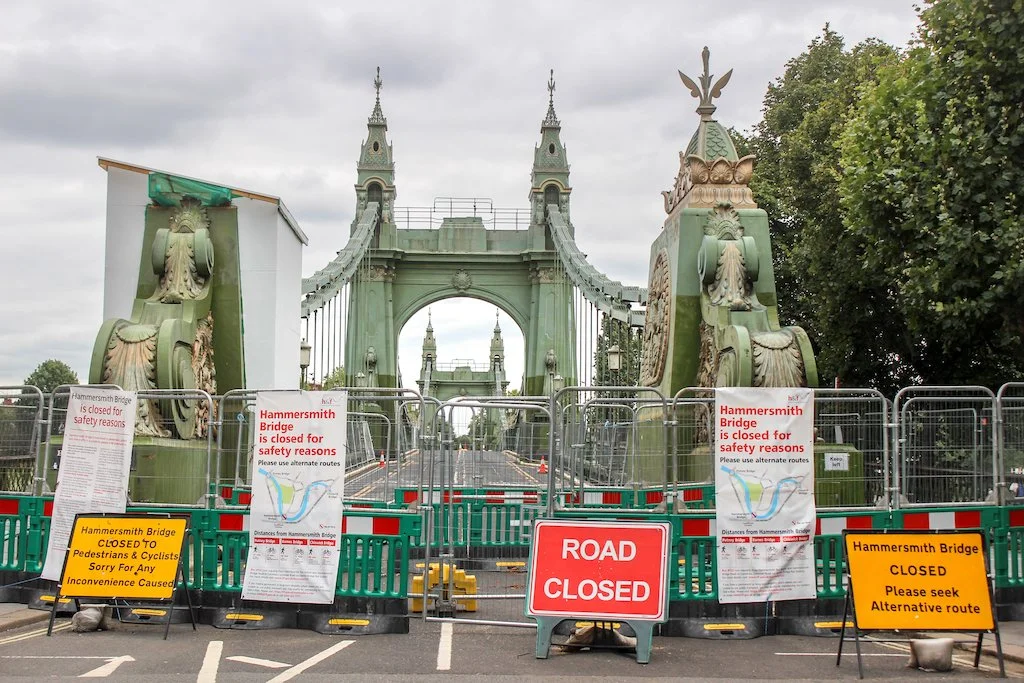
image: Shutterstock
Hammersmith Bridge, a Grade II-listed structure spanning the River Thames, has been closed to cars since April 2019 after structural cracks were discovered in its cast-iron components. Since then, the bridge has remained open only to pedestrians and cyclists, while long-term repair options have been under review.
The council’s latest assessment estimates that restoring the bridge to a condition suitable for buses and general traffic would cost around £300m. Officials say this level of work would effectively require rebuilding large sections of the structure, raising questions about whether full reinstatement is viable at all.
According to reporting based on the council’s findings, Hammersmith & Fulham Council has already spent approximately £54m on stabilisation and safety works since the closure. However, it stated that it cannot meet the additional costs required for full vehicular reopening without substantial external funding.
A key issue highlighted in the report is the funding arrangement between the council, Transport for London (TfL), and central government. Under a previously agreed cost-sharing model, the council is responsible for roughly one-third of expenses, with TfL and the Department for Transport covering the remainder. The council has argued that it is still owed contributions toward earlier works and continues to seek additional government support.
While the financial debate continues, usage patterns for the bridge have shifted significantly. Recent estimates suggest that more than 10,000–20,000 pedestrians and cyclists now cross daily, reflecting its continued importance as a local active travel route even without vehicle access.
The council report also suggests that, given the scale of deterioration and the cost of restoration, a phased approach focusing on essential structural repairs may be more realistic than full reinstatement. This would prioritise maintaining pedestrian and cycle access while ensuring the long-term safety of the structure.