
EU unveils ambitious high-speed rail plan aimed at transforming european travel
The European Union has announced a substantial new plan to accelerate the development of a continent-wide high-speed rail network, positioning rail as the backbone of sustainable long-distance travel across Europe. The proposal forms part of the revised Trans-European Transport Network (TEN-T) regulation, formally endorsed at the end of November in Brussels.
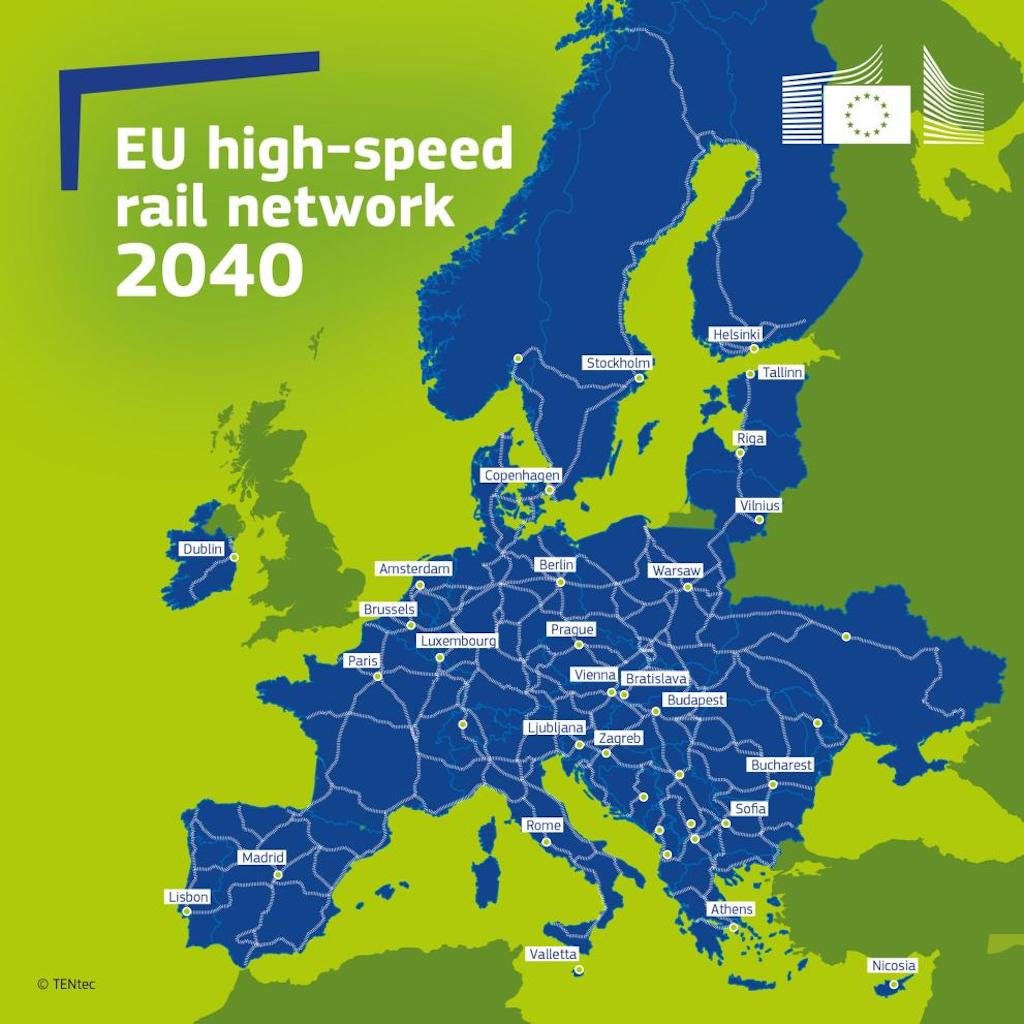
image: EU
Under the plan, the EU will require member states to complete key high-speed “core network” corridors by 2040, with a wider “comprehensive network” to follow by 2050. The backbone routes will link major capitals and economic centres, including Paris, Berlin, Madrid, Rome and Warsaw, with minimum operating speeds of 160–200 km/h for cross-border passenger services.
Several priority cross-border gaps—such as between Spain and France, Germany and the Czech Republic, and Italy and Slovenia—have been highlighted for accelerated delivery.
Officials say the strategy is designed to make high-speed trains a credible alternative to short-haul aviation and long-distance car travel. By improving journey times and reliability, the EU hopes to encourage millions of travellers to shift to rail, cutting emissions and congestion. Rail produces around one-tenth of the CO₂ emissions per passenger kilometre of air travel, making it central to the EU’s climate goals.
Member states will be required to coordinate delivery and harmonise standards – long seen as a major barriers to seamless high speed, cross-border rail travel in Europe.
Funding will come from a mix of EU grants, national budgets, and private investment, with the European Commission expected to publish a detailed financing package later this year.
If delivered as planned, the network would mark the most significant upgrade to European transport infrastructure in a generation—creating what EU transport commissioner Adina Vălean described as “a fast, reliable rail network that finally matches the way Europeans want to travel in the 21st century.”