
Connected intelligence: unlocking the grey space in UK transport

image: Fujitsu

Matt Mullen,
Chief Digital Officer – UK Transport & Logistics at Fujitsu
The UK transport sector is moving into one of its most transformative periods in decades. While much of this change is welcome, there is also growing attention on what Fujitsu’s UK Transport Chief Digital Officer, Matt Mullen, describes as the “grey space”
Devolution is reshaping what regions can control. Bus franchising is giving cities the ability to design coherent networks. Rail reform is moving us slowly toward more consistent system thinking. At the same time, operational technology and digital capability are converging, and new suppliers are emerging with specialised solutions at remarkable pace.
Much of this transformation is positive and long overdue. But beneath the progress lies something less visible, and increasingly important: the grey space.
The grey space is the layer between systems, suppliers, teams, contracts and data where information gets lost and decisions are made without the full picture.
Every part of the sector feels it, but at different levels of maturity. It’s the place where pilots work technically but struggle to scale; where modern solutions hit legacy constraints; where data exists but isn’t accessible at the moment it’s needed; and where innovative organisations sometimes lack the context to influence outcomes beyond their own scope.
The grey space isn’t a failure of the sector… it is a natural consequence of how UK transport has evolved
The grey space isn’t a failure of the sector, or of any particular organisation. It is a natural consequence of how UK transport has evolved: fragmented ownership structures, multiple operators, overlapping responsibilities, and technology that has historically been procured in isolation.
But what makes this moment different is that the grey space is becoming the biggest opportunity we have.
The reforms underway are creating the conditions to connect what has always been disconnected. Franchising and devolution give local authorities whole-system levers. Rail reform offers the potential for consistent standards and more integrated planning. Digital maturity allows data to flow where operational decisions are made. And a growing ecosystem of SMEs and suppliers are already designing with open architectures and interoperability in mind.
This alignment between governance, technology and capability hasn’t happened at this pace before. That’s why connected intelligence matters now.
Connected intelligence is the ability to connect data, insight and decision-making across organisational and contractual boundaries
Connected intelligence isn’t a platform or a technology. It’s a capability: the ability to connect data, insight and decision-making across organisational and contractual boundaries. It asks us to design interoperability into new procurements, build blended teams across OT, IT, asset management and operations, and think about systemic adoption rather than single-point solutions.
Most importantly, it helps us make better decisions across boundaries we don’t control.
This isn’t about creating new roles or new departments. It’s about small shifts in how we think, collaborate and design. It’s about acknowledging that every organisation in the ecosystem is now operating within a shared system, even if accountability and governance remain distributed.
The future of UK transport won’t be shaped by technology alone. It will be shaped by our ability to navigate and unlock the grey space—whether we’re a local authority planning a multimodal network, a bus operator deciding between coverage and ridership, a rail organisation modernising and converging the IT/OT space, or a supplier delivering innovation into complex estates.
This is the moment to connect what comes next.
Matt Mullen is Chief Digital Officer – UK Transport & Logistics at Fujitsu.
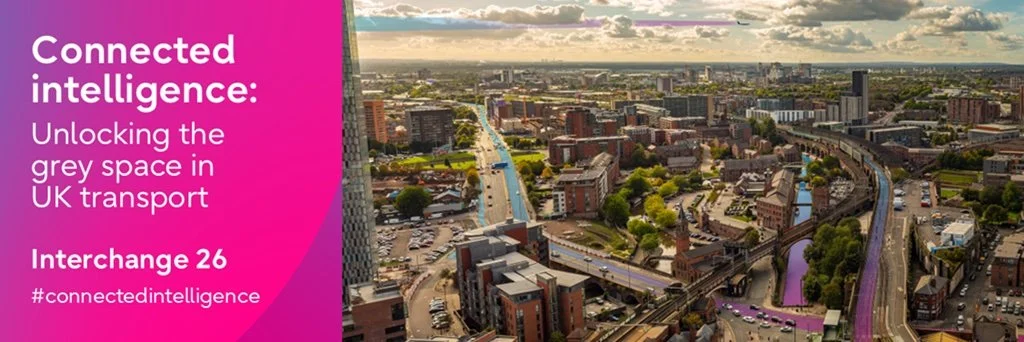
REGISTER FOR OUR WEBINAR NOW: Fujitsu and Interchange are co-hosting a webinar exploring these ideas further on 4 February in which Matt will be joined by Will Reddaway, Innovation Lead for Vodafone; Anne Marie Purcell, founder of Purcell Advisory and former Chief Transformation Officer at TfGM; and Thomas Ableman, founder of Freewheeling and former Director of Strategy and Innovation at TfL. The webinar is free to attend by register here