
Coventry advances VLR demonstrator and potential for affordable urban transit
Coventry City Council is preparing to progress the next phase of its Very Light Rail (VLR) project, with plans for an 800m twin-track demonstrator between Coventry railway station and the university technology park. The proposal, which will go before the council’s Cabinet later this month, builds on the successful testing of the VLR vehicle and track technology earlier this year.
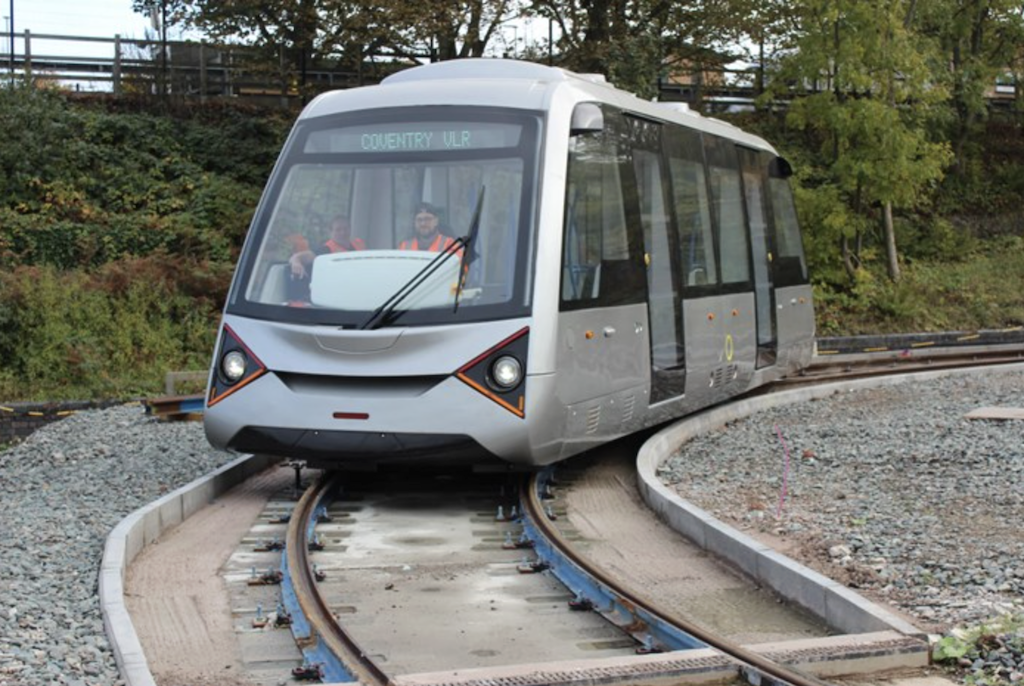
image: TfWM
Councillor Jim O’Boyle, Cabinet Member for Jobs, Regeneration and Climate Change, said the initiative represents “pioneering transport innovation,” adding that the system can be delivered at “less than half the cost and in half the time” of a conventional tram network.
A key element of Coventry’s model is the shallow, modular track system, made from precast concrete units designed to sit at significantly lower depths than traditional tram track.
Because the system avoids deep excavation, it reduces or removes the need to divert utilities – one of the most expensive and disruptive components of typical urban tramway construction. This approach aims to cut installation times, reduce carbon emissions during construction, and minimise disruption to road users and businesses.
The VLR vehicles themselves are battery-powered, eliminating the need for overhead wires and associated infrastructure. This further reduces capital cost and visual impact and allows for quicker installation on urban streets.
The project is significant because the high cost of traditional light rail systems has often prevented smaller and medium-sized cities from pursuing tram-based public transport. Projects in Edinburgh and Manchester, for example, have highlighted how complex enabling works — particularly utility diversions — can inflate costs and extend timelines. As a result, several cities have explored tram-style transit but abandoned proposals on affordability grounds.
Coventry’s VLR concept offers a potentially scalable, lower-cost alternative. If a viable system can be delivered at reduced cost and with less disruption, it could provide a pathway for other UK cities to introduce fixed-route, high-quality transit without the budget requirements typically associated with tram networks.
The Coventry demonstrator is funded through the City Region Sustainable Transport Settlement (CRSTS), with completion targeted for April 2027. The council hopes that showcasing the technology in a live urban setting will strengthen the business case for a wider city network and support potential adoption in other parts of the country.
The aim for Coventry is to serve the city with a 12km route connecting the West Midlands Investment zone, centred on GreenPower Park, with the development taking place around Ansty Park, both of which are set to create a wide range of new jobs.
During trials earlier this year, 200m of track was laid in just eight weeks – faster than any other track system. In the weeks after the rides the team was also able to show utility companies that access to cables and pipes under the track was quick and simple.
Councillor Jim O’Boyle cabinet member for jobs, regeneration and climate change said, “Coventry Very Light Rail is pioneering transport innovation. It is a cost-effective and efficient alternative to conventional tram systems and we have proven it can be delivered at less than half the cost and in half the time.
“We are on to a real transport game changer here. It will be good for the environment, have no unsightly overhead cables and in the future, it has the potential to be autonomous – offering a hop on and hop off service. What’s more I think everyone that saw it here, and rode it, can agree that it looked great in the street and gave a quiet and smooth ride. I’m looking forward to seeing it back and providing the chance for even more people to have a go on it.”