
Budget confirms funding to enable Lower Thames Crossing construction to start in 2026
Work is set to begin in 2026 on the long-planned Lower Thames Crossing (LTC) after the government’s latest Budget confirmed the final tranche of public funding needed for the project.
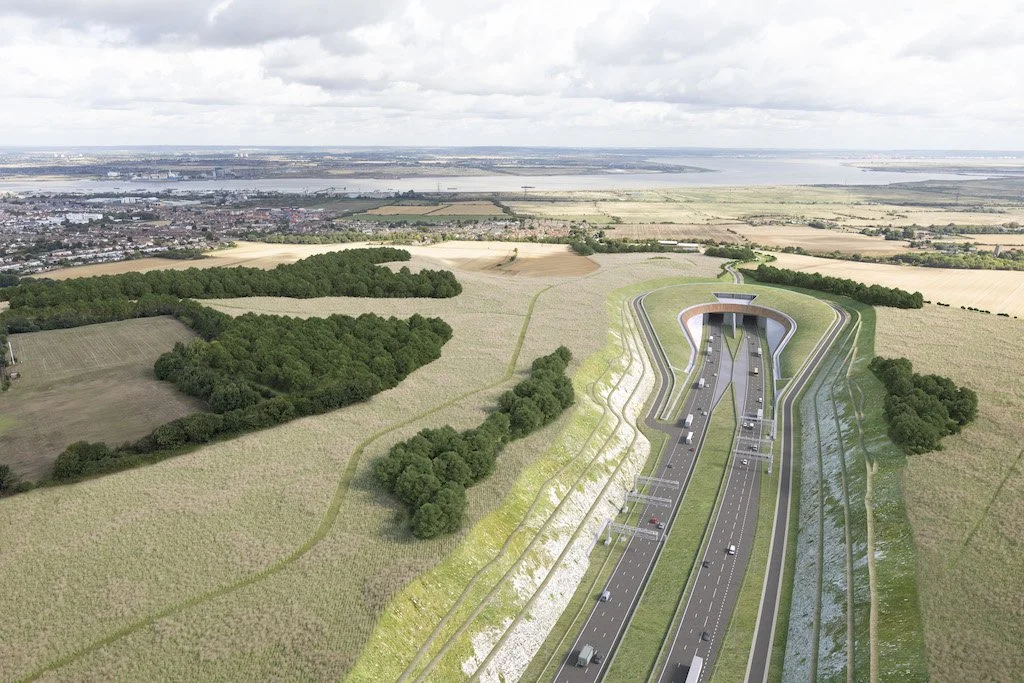
image: National HIghways
The funding announcement comes after the project — a 14.3-mile road and tunnel route linking Kent and Essex — received planning approval earlier this year.
Once complete, the LTC will include twin tunnels beneath the River Thames — the longest road tunnels in the UK — along with extensive new approach roads.
The scheme is designed to ease chronic congestion at the existing Dartford Crossing, significantly improve freight and commuter connections between the South East and Midlands/North, and support economic growth.
Matt Palmer, Executive Director of the Lower Thames Crossing, said, "The funding from government gives us the green light to start building the Lower Thames Crossing next year and puts it on track to open in the early 2030s.
“The project will be built by local people and businesses, and leave a legacy of jobs and skills across the region. It’s the first of a new generation of projects that will tackle congestion and drive economic growth, whilst redrawing the blueprint for low-carbon construction."
The three main delivery partners are already in place:
Bouygues Travaux Publics – Murphy Joint Venture (BMJV) — responsible for construction of the twin tunnels and associated approach works. This contract is valued at roughly £2.3 billion.
Balfour Beatty Civil Engineering — awarded the “roads north of the Thames” package, a £1.2 billion contract to build the northern approach roads, linking the tunnel to the A13 and M25.
Skanska Construction UK— tasked with delivering the southern (Kent) approach roads under a £450 million contract, connecting the tunnel south portal to the A2/M2 network.
Jacobs is Integration Partner — coordinating between the client and the contractors — while Turner & Townsend handles commercial management, cost assurance and contract oversight across the programme.
National Highways says detailed design work, ground investigations and measures to limit environmental and community disruption will continue before the start of full-scale construction.